Designing With Communities, Not For Them: What That Actually Looks Like
Designing with communities, not for them, turns a nice principle into real adoption. Here's what two-way, listening-led engagement looks like in practice.
Dr Emma Heywood5 min read
Plenty of project teams have adopted the language of co-design, meaning the practice of involving the people who will use something in shaping it. They write community engagement into the funding bid, hold a launch workshop, and mean every word of it. Then the timeline tightens, the important decisions get made in a room the community is not in, and the work quietly slides back to consulting people after the fact. Designing with communities, not for them, is easy to say and surprisingly hard to keep doing week to week. This post sets out what the difference actually looks like in a working project, and the traps that pull teams back.
Why does designing with communities change the outcome?
What we mean by designing with communities is straightforward: the people your innovation is meant to serve help shape it, from the questions asked at the start through to the decisions about what gets built, rather than being invited to react once the plan is largely set. Designing for them can be well-intentioned and still miss, because it assumes you already know what matters to them.
The evidence for this reaches well beyond any single sector. A six-country study of climate communications, drawing on more than 1,350 randomised controlled trials and around 83,000 respondents, found that messaging tends to fail when it is not grounded in what audiences actually value, such as health, cost and energy independence, as reported by CleanTechnica. The lesson generalises: work built on what people genuinely care about outperforms work broadcast at them.
For a project lead or a funder, this is not a point about virtue. It is about adoption. An innovation that people actually use is the outcome worth having, and it is also the evidence that stands up when a funder asks what your project changed. Good engagement also reduces risk: it surfaces the awkward problems early, while they are still cheap to fix.
What does designing with communities look like in another field?
Health journalists recently drew the same line in their own work. Writing for the Association of Health Care Journalists, they separated authentic community engagement, which means creating with readers, from audience engagement, which means creating for consumers. Two very different fields, health journalism and climate communication, arrived at the same distinction in the same month. That is a sign it is a general principle, not a slogan.
Imagine a team rolling out a new diagnostic device in a rural clinic. Designing for the clinic looks like a polished device, a training day, and a launch. Designing with it looks different: before anything is finalised, the team spends real time understanding how staff already work, what would make the device an extra burden, and who needs to trust it before anyone will use it. The first version often collapses when external support shifts. The second tends to hold, because it was built around how the work actually happens.
How do you design with communities in practice?
Designing with communities rests on listening-led engagement, which means designing your communication so that most of the effort goes into hearing from people before you decide what to do. Our shorthand for that balance is the 80:20 ratio: listen roughly 80% of the time, talk 20%. In practice, it looks like this:
- Start before the plan hardens. Engage while the important choices are still open. Listening after the design is fixed only confirms what you have already decided.
- Make it two-way. Share what you are learning back with the community and let it change your direction. Listening is only valuable if it visibly influences a decision.
- Gather evidence of adoption, not attendance. Count what people actually use and change, not how many turned up to a workshop. That evidence is what a funder can weigh.
- Write down what you heard and what you did about it. A short record of the trade-offs you made builds trust, and it is the backbone of a credible impact case.
- Protect the time. When the schedule slips, engagement is the first thing teams quietly drop. Treat it as core delivery, not a courtesy.
If you want a starting point for the practical side, our resources page collects field-tested checklists you can adapt, and the listening pillar goes deeper on the 80:20 ratio.
Frequently asked questions
What is the difference between designing with communities and designing for them?
Designing for communities means building something on their behalf and inviting them to react once the plan is set. Designing with them means the people your innovation serves help shape the questions and the decisions from the start. The first can be well-meant and still miss what matters; the second is more likely to be adopted.
Is community engagement worth the extra time on a tight project?
In many projects it saves time overall, because it surfaces problems early, while they are cheap to fix, rather than after launch when they are expensive. It also produces the evidence of adoption that funders increasingly ask for.
When should engagement start?
As early as possible, before the key design decisions have been made. Engagement that begins after the plan is fixed can only validate choices already taken, which is the trap that turns co-design back into consultation.
The projects that get adopted are usually the ones that listened first, and kept listening after the plan was set. If you would like to talk through how listening-led engagement could strengthen your project, get in touch about consultancy or training. We are happy to discuss what would actually help, with no obligation.
More to read
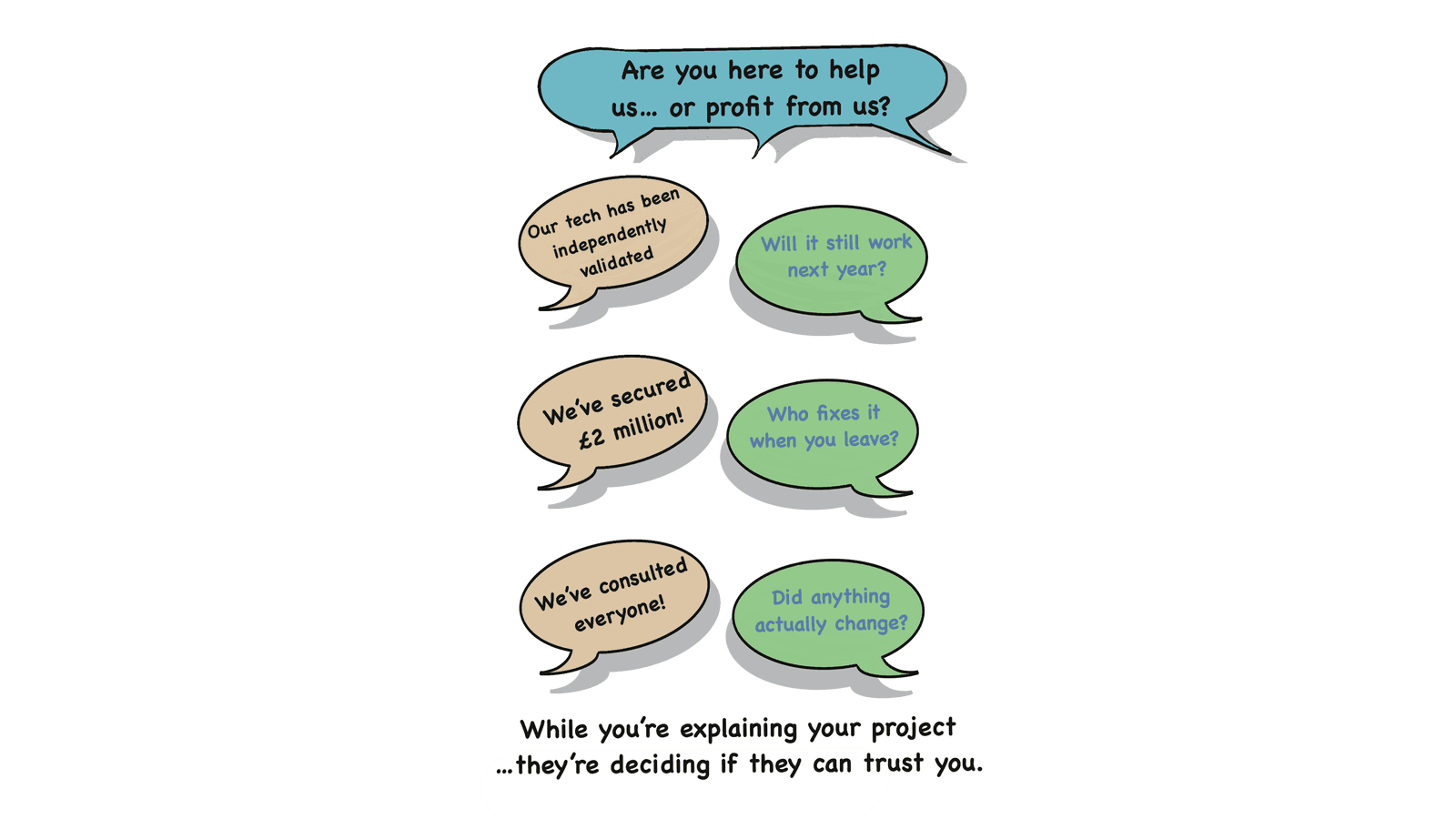
Are you here to help us or profit from us?
Communities assess project teams as carefully as teams assess them. Learn how transparency, listening and consistent action build lasting trust.
Five Persistent Myths About Community Engagement
Community engagement fails for predictable reasons. Five common myths about participation, and what listening-led practice does differently in their place.