Five Persistent Myths About Community Engagement
Community engagement fails for predictable reasons. Five common myths about participation, and what listening-led practice does differently in their place.
Dr Emma Heywood6 min read
- community engagement
- participation
- development
Community participation has become a routine expectation in development. It appears in funding criteria, evaluation frameworks, and professional guidelines across infrastructure, health, energy, education, and governance. The underlying idea is widely accepted: people should have a say in decisions that affect their lives, and involving them should produce better, more durable outcomes. Yet community engagement so often disappoints. Projects described as community-led struggle to shift decision-making power, fail to build trust, or lose momentum the moment external support is withdrawn.
This is rarely because the people involved lack commitment. More often it reflects a gap between how participation is talked about and how it actually plays out, particularly in contexts shaped by inequality, limited institutional capacity, and long histories of externally driven intervention. Here are five persistent myths about community engagement, and what a listening-led approach does instead. By community engagement we mean the work of designing with communities, not for them; listening-led means treating sustained listening, not consultation theatre, as the core of that work.
Why isn't attending a meeting the same as having influence?
The first myth is that participation equals influence. Engagement is usually organised around meetings, workshops, and consultation sessions where community members are invited to attend and respond. These spaces can be useful, but the range of decisions participants can realistically affect is often narrow. Design, budget, timelines, and ownership are frequently settled before engagement begins.
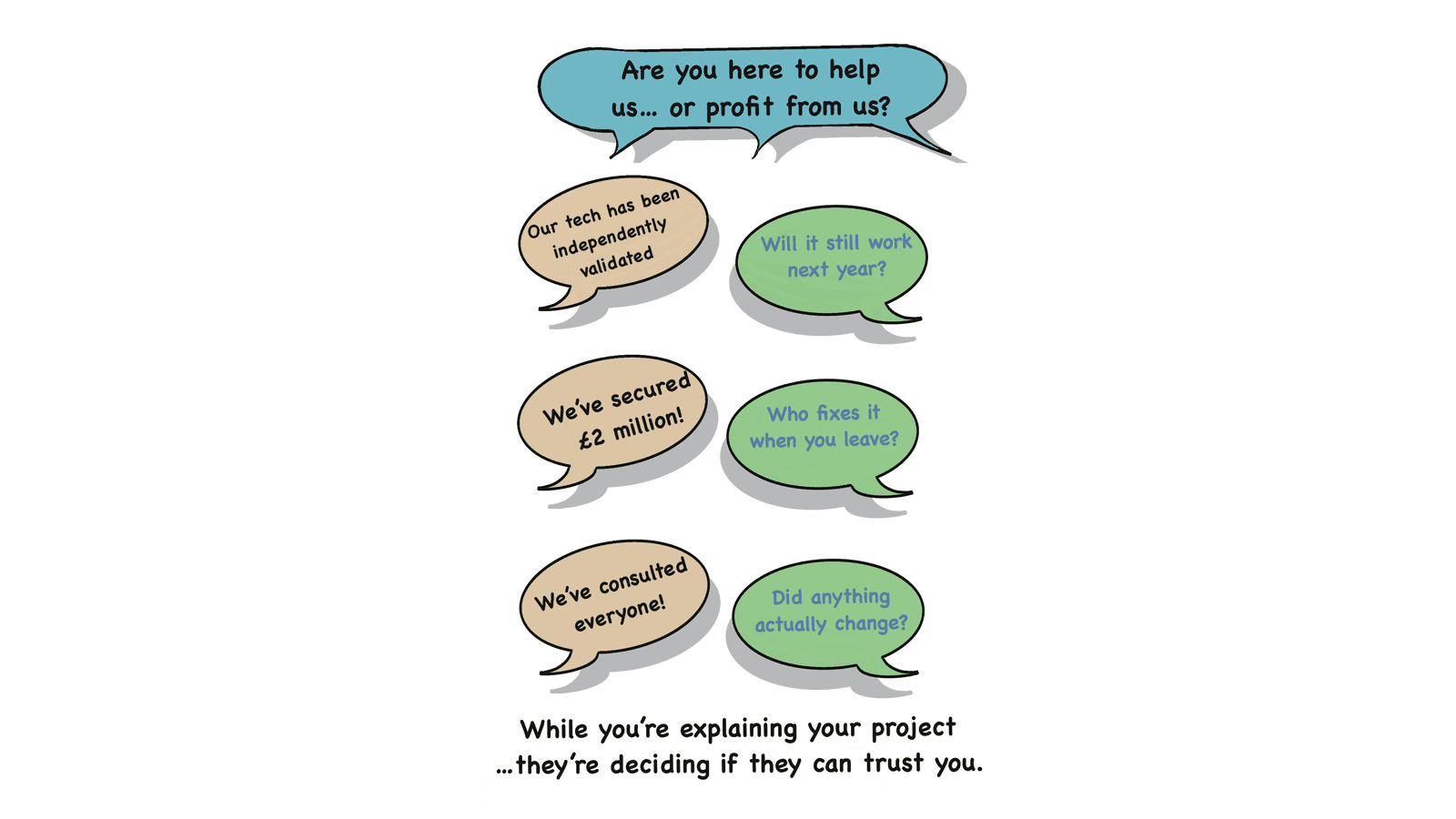
People recognise this quickly. Over time, participation becomes less about shaping outcomes and more about staying informed, maintaining relationships, or avoiding conflict. Attendance does not signal agreement or ownership; it may simply reflect an understanding of where influence actually lies. What people watch most closely is not whether they were consulted, but how project actors behave over time: Are commitments honoured? Are problems acknowledged? Does anyone return when something breaks? Participation, as experienced on the ground, is tied to reliability and responsiveness, not to voice alone. This is why so many new products and projects fail despite sound technology.
Why is a village not automatically a community?
The second myth treats shared location as a proxy for shared community. Projects assume that people in the same village or neighbourhood form a coherent group with common priorities and equal capacity to take part. In reality, communities are internally diverse. Gender, age, livelihood, income, mobility, and social standing all shape who can attend, who feels able to speak, and whose concerns are taken seriously.
When engagement ignores these differences, it tends to mirror existing patterns of influence rather than change them. Those with more time, confidence, or social authority become more visible; others are excluded in quieter ways. The result can look inclusive from the outside while feeling uneven to those inside it. A more grounded starting point is relationships rather than boundaries. People experience collective life through family networks, work groups, savings associations, faith communities, and informal support systems. Engagement that aligns with these existing relationships feels more relevant and is far easier to sustain than engagement built around formal public meetings alone.
What happens when participation is treated as if it were free?
The third myth is that participation costs nothing. It is work. Meetings, training, committee roles, monitoring, and maintenance all take time and effort, and they compete directly with income-generating activity, care responsibilities, and daily survival.
These costs are not evenly shared. People with stable incomes or flexible schedules can attend meetings during working hours; women and those in informal or subsistence livelihoods often cannot. Meanwhile, the professionals running participatory processes are paid for their time, while community members are not. When participation declines, this is often read as a lack of interest. It is better understood as a rational response to competing demands, and treating time as if it were free adds pressure to those already carrying the heaviest loads.
Why does starting with what a community lacks backfire?
The fourth myth is that engagement should begin with needs. Needs assessments are a common entry point, and identifying problems is necessary, but a narrow focus on deficits obscures the skills, systems, and forms of organisation a community already has.
Communities maintain infrastructure, manage shared resources, and support one another through informal arrangements long before any project arrives. These practices are real capacity, even when they are not formally recognised. Projects that work with existing arrangements adapt more easily to local conditions and tend to outlast the intervention itself. Starting from assets does not mean ignoring hardship; it means recognising that people are already doing substantial work to sustain their lives. Engagement built on that reality feels grounded rather than imposed, and it is the same instinct behind why listening before broadcasting earns trust.
Can participation on its own repair broken trust?
The fifth myth is that participation, by itself, can rebuild long-standing mistrust. Many communities have lived through projects that failed, stalled, or ended without explanation: infrastructure installed and abandoned, promises made and not kept. These experiences shape how new initiatives are received.
Participation is often expected to repair this through dialogue alone. That places a heavy burden on process while overlooking behaviour over time. Trust grows when institutions act consistently, acknowledge mistakes, and stay present when difficulties arise. Returning after a failure, explaining what went wrong, and involving local actors in the repair usually matter more than how participatory a project looked at the design stage. Without follow-through and accountability, participation feels procedural rather than connected to real responsibility.
Taken together, these myths point to a single error: treating participation as a set of techniques applied regardless of context. In practice it is shaped by power, time, relationships, and history. Ignoring those factors does not make participation neutral: it makes it fragile. A more honest approach treats engagement as an ongoing relationship: being clear about which decisions are genuinely open, recognising the costs people incur, and being realistic about what participation can achieve. It develops through consistent behaviour and time. Read more about how we work or start a conversation about a project of your own.
Frequently asked questions
What is the difference between participation and influence in community engagement? Participation describes being present and consulted: attending meetings, joining workshops, giving feedback. Influence is the ability to change a decision. The two are often confused, but people quickly notice when core choices about design, budget, or ownership were settled before they were ever invited in. Genuine engagement widens the range of decisions that are actually open.
Why do community development projects struggle to build trust? Trust is historical and relational, not procedural. Communities remember earlier projects that failed or made promises that were never kept, and those memories shape how new initiatives are received. Consultation alone cannot undo that. Trust is rebuilt through consistency, accountability, and returning after failure to put things right.
What does an asset-based approach to community engagement mean? It means starting with what a community already has, its skills, social groups, local knowledge, and informal systems, rather than only with what it lacks. Projects that build on existing capacity adapt better to local conditions and are more likely to last beyond the life of the intervention.