Are you here to help us or profit from us?
Communities assess project teams as carefully as teams assess them. Learn how transparency, listening and consistent action build lasting trust.
Dr Emma Heywood4 min read
- LMICs
- Researchers
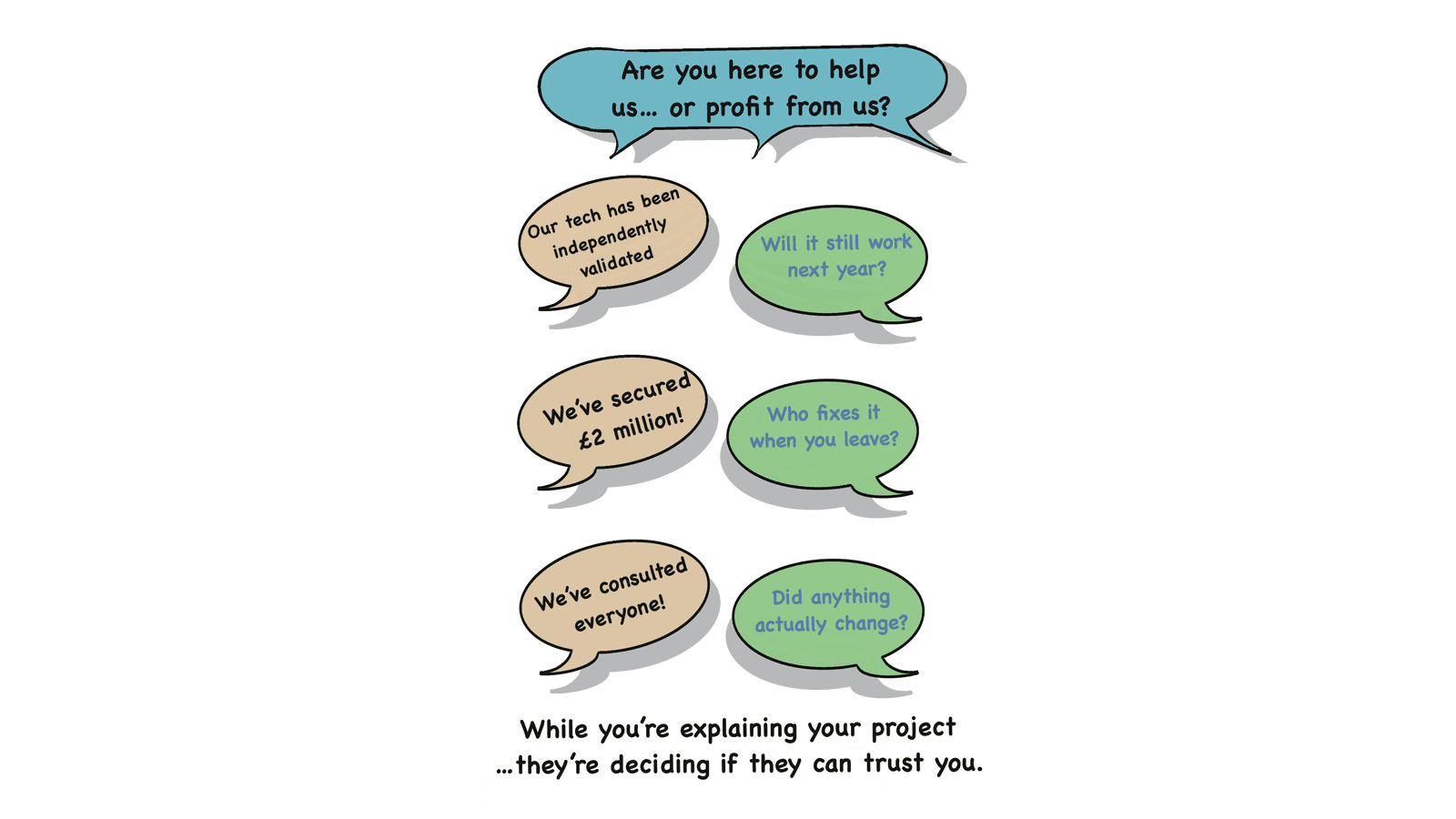
Communities aren't just listening to you. They're assessing you.
A partner I work with recently made a really interesting point.
“Communities are often are often trying to work out one simple thing: 'Are you here to help us or profit from us?'"
At first, it sounded quite cynical. But the more I reflected on it, the more I realised it was neither cynical nor unreasonable. In fact, it might be one of the most important questions any community asks when an unfamiliar organisation arrives with a new project.
We spend a lot of time talking about how researchers and innovators should understand communities. We encourage stakeholder mapping, contextual analysis, listening exercises and co-design workshops. All of these are valuable.
What we talk about far less is that exactly the same process is happening in reverse.
While we are trying to understand communities, communities are trying to understand us.
They are asking questions that may never appear on a project logframe or evaluation form. Can we trust you? Will you listen? What do you really want from us? Will you still be here in two years? Who benefits if this succeeds?
In other words, they are assessing us just as carefully as we are assessing them.
I have seen this repeatedly during research and community engagement work in West Africa. Conversations that were intended to be about the project itself would often begin somewhere completely different. Before people wanted to discuss the research questions, they wanted to understand who we were, why we were there, who had funded the work and what would happen once the project finished. Those weren't distractions from the research. They were the foundation on which any meaningful conversation depended.
Looking back, I realise they weren't simply gathering information. They were deciding whether we were worth trusting.
That makes perfect sense.
Many communities have seen projects come and go. They have welcomed researchers, NGOs, businesses and government agencies, each arriving with genuine enthusiasm and good intentions. Some projects have made a lasting difference. Others have disappeared as soon as the funding ended. Some have collected valuable knowledge without communities ever seeing the results. Others have promised more than they could realistically deliver.
Communities carry those experiences with them. Every new project is judged in the light of previous ones.
This is why I don't think the question is really about profit.
There is nothing inherently wrong with organisations benefiting from their work. Businesses need to generate income. Universities build knowledge and reputations. NGOs secure future funding. Consultants make a living from their expertise. Those things are not incompatible with creating positive social change.
The problem arises when organisations assume that good intentions are enough to build trust.
They aren't.
Most organisations answer the question, "Are you here to help us or profit from us?", with words.
Communities answer it by watching.
They notice whether meetings are used to genuinely shape decisions or simply communicate decisions that have already been made. They notice whether local knowledge changes the direction of a project or is politely acknowledged and then ignored. They notice whether local partners are treated as equal collaborators or simply as a route into the community.
Perhaps most importantly, they notice what happens when things become difficult. Does the organisation adapt? Does it admit mistakes? Does it continue listening? Or does it quietly move on to the next project?
Trust is built through these moments, not through mission statements.
This is one of the reasons I believe community engagement is often misunderstood. It is sometimes presented as a way of helping organisations understand the people they work with. That is certainly part of it.
But community engagement is also about allowing communities to understand the organisations that want to work with them.
Every conversation, every promise and every decision answers the same underlying question.
Are you here because this community matters?
Or because your project does?
Most organisations would say the first.
The more interesting question is whether the community would agree.
If you're working on research or innovation in low- and middle-income countries and would like to discuss how community engagement can strengthen your project, I'd love to hear from you.
Email: emma.heywood@the80-20pathway.com
Website: the80-20pathway.com